Since the 2025-26 school year is in full swing, I’ll be blogging about a few picture books involving learning and/or school over the next few weeks. I love this time of year with the spirit of new classes and discovery in the air!
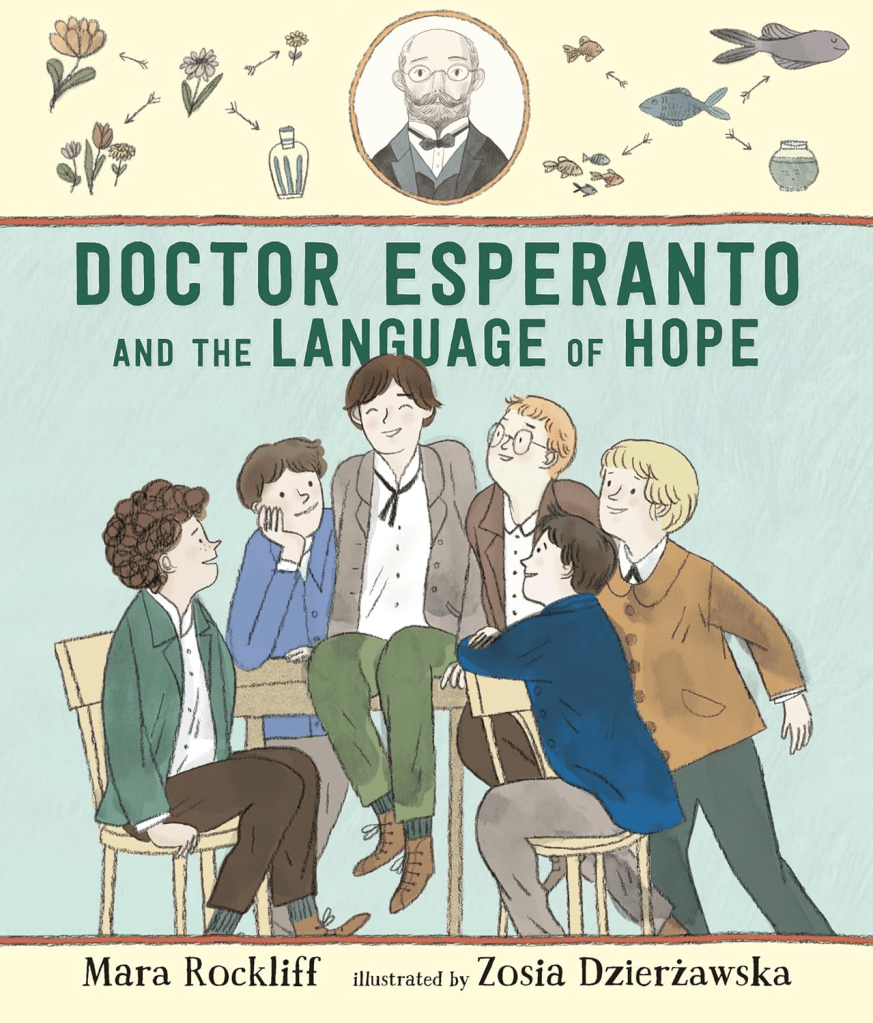
Today’s book is shown above. It’s all about the back story of Esperanto, a language that was entirely made up by one person, instead of evolving organically amongst a group of people over lots of time.
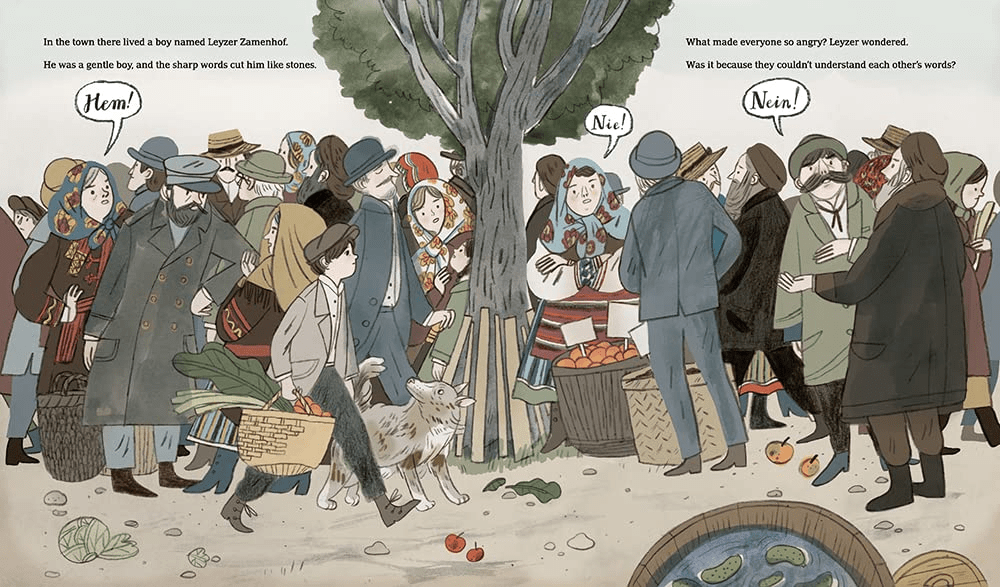
Who is the guy behind Esperanto? His name is Leyzer Zamenhof. The book shows young Leyzer Zamenhoff, a Jewish boy growing up in a small village under Russian rule (it never says where but an Internet search tells me it is in what is now Poland). He felt frustrated that the villagers spoke different languages instead of everyone speaking the same language. People talked sharply to each other and got into arguments. Leyzer wondered if this was because they didn’t know and speak the same words. The languages represented in the book spoken in his village are Russian, German, Polish, and Hebrew. Each speaker naturally thought his or her own language was the best. Leyzer studied Latin, Greek and Hebrew in school but discovered these were hard to learn, so the implication is that he gave up learning to speak them.
So he decided to make up his own language. At first he made words from scratch. Then, in what sounds like an attempt to make a Lego language of duplicatable, predictable, buildable parts, even though Legos weren’t invented yet, he made up words borrowing pieces from many different languages and made them fit together into a beautiful thing, like a Lego castle.
So for example, as a double-page in the book shows:
-a fish is “fiso”
-a little fish is “fiseto”
-a big fish is “fisego”
-more than one fish is “fisaro”
-a fish container is “fisujo”
Then we have the following for another object:
-a flower is “floro” in Esperanto
-a little flower is “floreto”
-a big flower is “florego”
-more than one flower if “floraro”
-a flower container is “florugo”
Do you see the common building blocks to represent the different aspects of an object? Big, little, plural, singular, etc. The different words have different roots but then the same ending to represent the same aspect. It’s a Lego language!
Young Leyzer didn’t have the support of his father to publicize his Lego language. His father told him to go to medical school and leave his Lego language behind. On a break, Leyzer came home to discover his father had burned all his papers about his constructed language. But it was all still in his mind! He wrote everything down again and refined it to be even better, simpler and more beautiful. With his friend Clara’s help, he published his invention of a language into a book and called himself, the author, “Doctor Esperanto.” In his language, “esperanto” means “one who hopes.” He hoped for peace from a universal language.
People read the book and wrote him letters and eventually invited him to a conference about Esperanto in Paris. He attended and met his fans. He realized his dream had come true, that people from all over the world could meet together and talk in one language, Esperanto!

I highly recommend this book. The illustrations are beautifully clean and crisp, the story never lags, and it’s about a real person following a hero’s journey, a call. My favorite kind of picture book! So go find it at your public library and read it!
I have a funny story to share about Esperanto. Years ago, when my husband and I were the parents of three little children, we attended our first homeschooling conference together. It was a Charlotte Mason philosophy conference presented by author and veteran homeschooling mom Catherine Levison. We went with two other couples who are dear friends and enjoyed sitting by them. Maybe it was the fact that my husband had some chummy people with him that egged him on to be in a humorous mood. Catherine was up there, going through each subject for a typical homeschool family and talking about who Charlotte Mason recommends each subject should be taught. So for the foreign language topic she said that Charlotte Mason recommended teaching a foreign language by getting a fluent, native speaker to talk to the child regularly. My husband, ever the clown, raised his hand and asked “Now how does that work with Esperanto?” My friends and I all laughed. He got the desired reaction from us, and to Catherine’s credit, she didn’t let the fun-inducing question derail her and she moved on.
Anyway, if you want to learn something new this fall, go learn Esperanto! A website for it is here, and you can find it in Duo Lingo.
Guess what? I just learned that I guess because Esperanto has been around for over 100 years, the world now has about 2000 native speakers of Esperanto, according to YouTube. Fascinating! Here’s one of them below. Dear husband is skeptical, maybe because it ruins his joke, LOL.
 Tree of Life Mothering