

I finally made the pilgrimage every fan of the Little Women novel desires to do! This has made my summer of 2024 one of the best summers ever! (It rivals the summers I got married and gave birth.) As part of my East Coast trip to see my sister in Maine, I got to visit Orchard House in Concord, Massachusetts! This is the place where the author of Little Women, Louisa May Alcott, lived in her adult years. It is the place where she wrote Little Women. I presume that she wrote all of her subsequent novels there as well.

You can find Orchard House about 24 miles northwest of Boston. Louisa moved into this home as an adult, in 1858, in the year she turned 26. Years later, in the summer of 1868, when she was 35, she wrote the classic book of girlhood that catapulted her to fame, making her the J.K. Rowling of her day. She ended up making around $22 million in today’s money from her books. Wow!
At that point she could have bought a fancier house no doubt so I guess she was attached to this humble home that she affectionately called “Apple Slump.”

This is not the home, however, where the LW story takes place. That home was called Hillside by the Alcotts. It is on the same street, Lexington Road, maybe a hundred yards away from Orchard House to the east. That is where she lived as a little girl. It later became known as Wayside, where Nathaniel Hawthorne lived, as well as the author of Five Little Peppers, Harriet Lothrop, aka Margaret Sidney. Concord MA was just full of famous authors! Ralph Waldo Emerson and Henry David Thoreau were among some of those. We also visited the cemetery in Concord where some of the aforementioned authors are buried with the Alcott family. It’s just a short hop, skip, and a jump away. That’s another blog for another day as well!

August 15, 2024 will forever be a wonderful, memorable day for me. It’s the day I got to visit Orchard House and the day Jana Duggar got married. So while Jana was enjoying a day she had waited so long for (she married at age 34, far older than her younger sisters were when they married), I too was enjoying a day I had anticipated for many years. The fact that I got to visit Orchard House with one of my sisters, three of my nieces, a nephew, my youngest son, my oldest daughter, my son-in-law, and two of my grandsons made the visit even more special. It would have been perfect if my husband, mom, other sister, and the rest of my nieces had been there. Hopefully that will happen! The rest of the boys can all come too of course, I just wonder if they will be bored. My 15-year-old son tolerated the tour OK but he wasn’t exclaiming with joy like I was. 🙂

It was just so dreamlike to walk into the home, and then the very room, and then see the very desk where LMA wrote Little Women. (I will blog another day about Orchard House itself.) Becoming wrapped up in the Little Women story is not like being enamored with Harry Potter, where the story is all fictional and symbolic. You can’t go to England and find the Hogwarts school or where Harry lived with his awful relatives, in his dungeon closet. By contrast, Little Women is based on a real family, Louisa’s very own, including her parents, Bronson and Abigail May, and their four daughters. The whole story is based on a family’s desire to live a godly life. I don’t know how to explain it, but to actually be there where they lived makes them more real, and therefore the truths of the story they lived sink deeper into my heart when I am there and forever more. About 80-85% of the objects in the home were owned by the Alcotts. You can see May/Amy’s artwork, Louisa/Jo’s boots that she wore as “Roderigo,” Beth’s melodeon (like a piano), Anna/Meg’s wedding dress, Marmee’s kitchen sink that Louisa bought for $100, and many other items. Apparently, minimalism wasn’t a thing with the Alcotts, they saved everything. Lucky us!

What’s better than seeing these artifacts is seeing God in the Little Women story. It’s not as hard as with some other books. You can actually find God in Harry Potter, as I have learned since I first banned the book from our home as young mom, when I thought it was godless. See my post about that here. It took a book and podcast to help me with that.


God, however, is much easier to find in Little Women. Especially if you read the actual book. If your only experience with Little Women is watching one of the movie versions of the novel (1939, 1949, 1994, 2019) then you are most likely missing out on the religious foundation of the book. If you read the book, and take the time to observe, you will note not just hints but outright references to God and His plan throughout this timeless story.

(I watched the 1994 version, shown above, in 1995, at a special movie night with many of my sisters-in-law. I was pregnant with my oldest daughter. How fitting that almost 29 years later I could visit Orchard House with the same daughter and her own family in tow. Oh the feels!)

So, here we go. What follows are all the mentions of God in the book Little Women, beyond the “Thank God” and the “God bless you” phrases.
First and foremost, the theme of The Pilgrim’s Progress is the basis of the book. The Pilgrim’s Progress was a decidedly, unabashedly Christian book written by John Bunyan in 1678. It shows the path of the main character, Christian, as he undertakes a journey to get to the Celestial City to be with God (heaven). It’s an allegory of the Plan of Salvation, the Hero’s Journey that we are all on to have joy from God. One of my church leaders gave a great talk about this Journey, called “Your Great Adventure.”
We see The Pilgrim’s Progress journey mentioned in the very first chapter of Little Women, the title of which is “Playing Pilgrims.” Here is an excerpt from that chapter:
Mrs. March broke the silence that followed Jo’s words, by saying in her cheery voice, “Do you remember how you used to play Pilgrims Progress when you were little things? Nothing delighted you more than to have me tie my piece bags on your backs for burdens, give you hats and sticks and rolls of paper, and let you travel through the house from the cellar, which was the City of Destruction, up, up, to the housetop, where you had all the lovely things you could collect to make a Celestial City.”
“What fun it was, especially going by the lions, fighting Apollyon, and passing through the valley where the hob-goblins were,” said Jo.
“I liked the place where the bundles fell off and tumbled downstairs,” said Meg.
“I don’t remember much about it, except that I was afraid of the cellar and the dark entry, and always liked the cake and milk we had up at the top. If I wasn’t too old for such things, I’d rather like to play it over again,” said Amy, who began to talk of renouncing childish things at the mature age of twelve.
“We never are too old for this, my dear, because it is a play we are playing all the time in one way or another. Our burdens are here, our road is before us, and the longing for goodness and happiness is the guide that leads us through many troubles and mistakes to the peace which is a true Celestial City. Now, my little pilgrims, suppose you begin again, not in play, but in earnest, and see how far on you can get before Father comes home.”

With those words, the Christian pilgrim theme is set for the book. In the story, each of the girls works as a pilgrim, seeking to let go of her burden by overcoming her primary fault. Meg’s is vanity, for Jo it’s her temper, Beth’s is her shyness, and Amy has selfishness. Each chapter that features the girls struggling with her fault refers to some place or thing in the Pilgrim’s Progress story.
Chapter Six: Beth Finds the Palace Beautiful
Chapter Seven: Amy’s Valley of Humiliation
Chapter 8: Jo Meets Apollyon
Chapter 9: Meg Goes to Vanity Fair
Next, also in the first chapter, we see a veiled hint of Christianity. Mrs. March tells the girls to look under their pillows on Christmas morning to see a guidebook for their own pilgrim’s progress.
Jo was the first to wake in the gray dawn of Christmas morning. No stockings hung at the fireplace, and for a moment she felt as much disappointed as she did long ago, when her little sock fell down because it was crammed so full of goodies. Then she remembered her mother’s promise and, slipping her hand under her pillow, drew out a little crimson-covered book. She knew it very well, for it was that beautiful old story of the best life ever lived, and Jo felt that it was a true guidebook for any pilgrim going on a long journey. She woke Meg with a “Merry Christmas,” and bade her see what was under her pillow. A green-covered book appeared, with the same picture inside, and a few words written by their mother, which made their one present very precious in their eyes. Presently Beth and Amy woke to rummage and find their little books also, one dove-colored, the other blue, and all sat looking at and talking about them, while the east grew rosy with the coming day.
In spite of her small vanities, Margaret had a sweet and pious nature, which unconsciously influenced her sisters, especially Jo, who loved her very tenderly, and obeyed her because her advice was so gently given.
“Girls,” said Meg seriously, looking from the tumbled head beside her to the two little night-capped ones in the room beyond, “Mother wants us to read and love and mind these books, and we must begin at once. We used to be faithful about it, but since Father went away and all this war trouble unsettled us, we have neglected many things. You can do as you please, but I shall keep my book on the table here and read a little every morning as soon as I wake, for I know it will do me good and help me through the day.”
Then she opened her new book and began to read. Jo put her arm round her and, leaning cheek to cheek, read also, with the quiet expression so seldom seen on her restless face.
“How good Meg is! Come, Amy, let’s do as they do. I’ll help you with the hard words, and they’ll explain things if we don’t understand,” whispered Beth, very much impressed by the pretty books and her sisters’ example.
“I’m glad mine is blue,” said Amy. and then the rooms were very still while the pages were softly turned, and the winter sunshine crept in to touch the bright heads and serious faces with a Christmas greeting.
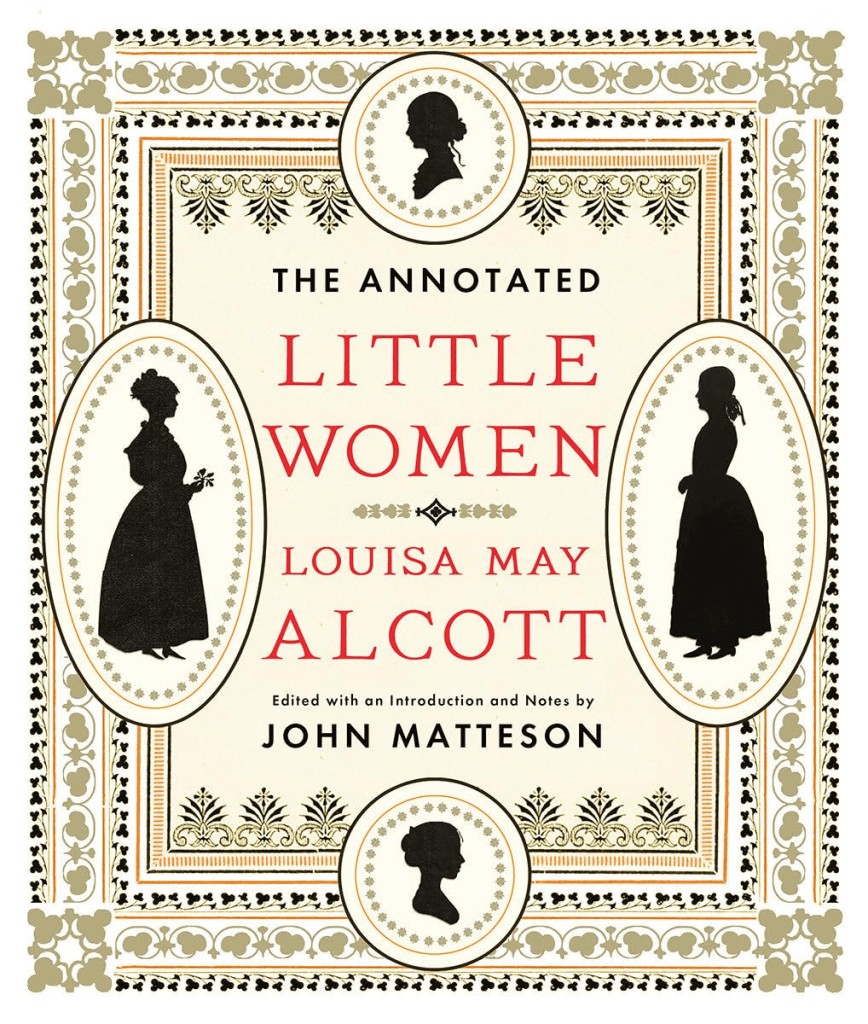
What is this book? It is the New Testament. In the annotated version of Little Women, compiled and edited by John Matteson, he writes, “Scholars have debated whether it is New Testament or copies of The Pilgrim’s Progress that Marmee gives the girls as Christmas presents. Lizzie Alcott’s New Testament, recently discovered at Orchard House, helps settle the issue.” (p. 22)
I just love that LMA refers to the subject of the New Testament book, Jesus, as the “best life ever lived.” Yes indeed. A subtle endorsement of the Savior Jesus Christ.
Then we have Marmee’s counsel to Jo as they talk about Jo’s temper that flared up when she found out Amy had burned her writing book. It’s bedtime, and Jo and Marmee also discuss Marmee’s emotions at her husband’s departure to serve in the war effort as a chaplain.
“I gave my best to the country I love, and kept my tears till he was gone. Why should I complain, when we both have merely done our duty and will surely be the happier for it in the end? If I don’t seem to need help, it is because I have a better friend, even than Father, to comfort and sustain me. My child, the troubles and temptations of your life are beginning and may be many, but you can overcome and outlive them all if you learn to feel the strength and tenderness of your Heavenly Father as you do that of your earthly one. The more you love and trust Him, the nearer you will feel to Him, and the less you will depend on human power and wisdom. His love and care never tire or change, can never be taken from you, but may become the source of lifelong peace, happiness, and strength. Believe this heartily, and go to God with all your little cares, and hopes, and sins, and sorrows, as freely and confidingly as you come to your mother.”
Jo’s only answer was to hold her mother close, and in the silence which followed the sincerest prayer she had ever prayed left her heart without words. For in that sad yet happy hour, she had learned not only the bitterness of remorse and despair, but the sweetness of self-denial and self-control, and led by her mother’s hand, she had drawn nearer to the Friend who always welcomes every child with a love stronger than that of any father, tenderer than that of any mother.
When Meg has a bout with her vanity at the ball (her Vanity Fair) given by her glamorous friend Sally Moffat, her mother tells the girls:
“I want my daughters to be beautiful, accomplished, and good. To be admired, loved, and respected. To have a happy youth, to be well and wisely married, and to lead useful, pleasant lives, with as little care and sorrow to try them as God sees fit to send. To be loved and chosen by a good man is the best and sweetest thing which can happen to a woman, and I sincerely hope my girls may know this beautiful experience. It is natural to think of it, Meg, right to hope and wait for it, and wise to prepare for it, so that when the happy time comes, you may feel ready for the duties and worthy of the joy. My dear girls, I am ambitious for you, but not to have you make a dash in the world, marry rich men merely because they are rich, or have splendid houses, which are not homes because love is wanting. Money is a needful and precious thing, and when well used, a noble thing, but I never want you to think it is the first or only prize to strive for. I’d rather see you poor men’s wives, if you were happy, beloved, contented, than queens on thrones, without self-respect and peace.”
We see mention of this “Friend” who is either God in the form of Heavenly Father or God in the form of Heavenly Father’s Only Begotten Son, Jesus Christ, later on again in Chapter 22. It’s entitled “Amy’s Will.” In this chapter, Amy draws up a will while she is staying at the home of Aunt March, where she is sent away when Beth becomes ill.
The little girl was very sincere in all this, for being left alone outside the safe home nest, she felt the need of some kind hand to hold by so sorely that she instinctively turned to the strong and tender Friend, whose fatherly love most closely surrounds His little children. She missed her mother’s help to understand and rule herself, but having been taught where to look, she did her best to find the way and walk in it confidingly. But, Amy was a young pilgrim, and just now her burden seemed very heavy. She tried to forget herself, to keep cheerful, and be satisfied with doing right, though no one saw or praised her for it. In her first effort at being very, very good, she decided to make her will, as Aunt March had done, so that if she did fall ill and die, her possessions might be justly and generously divided. It cost her a pang even to think of giving up the little treasures which in her eyes were as precious as the old lady’s jewels.
How sweet! She remembers her mother teaching her about the “strong and tender Friend, whose father love most closely surrounds His little children.”
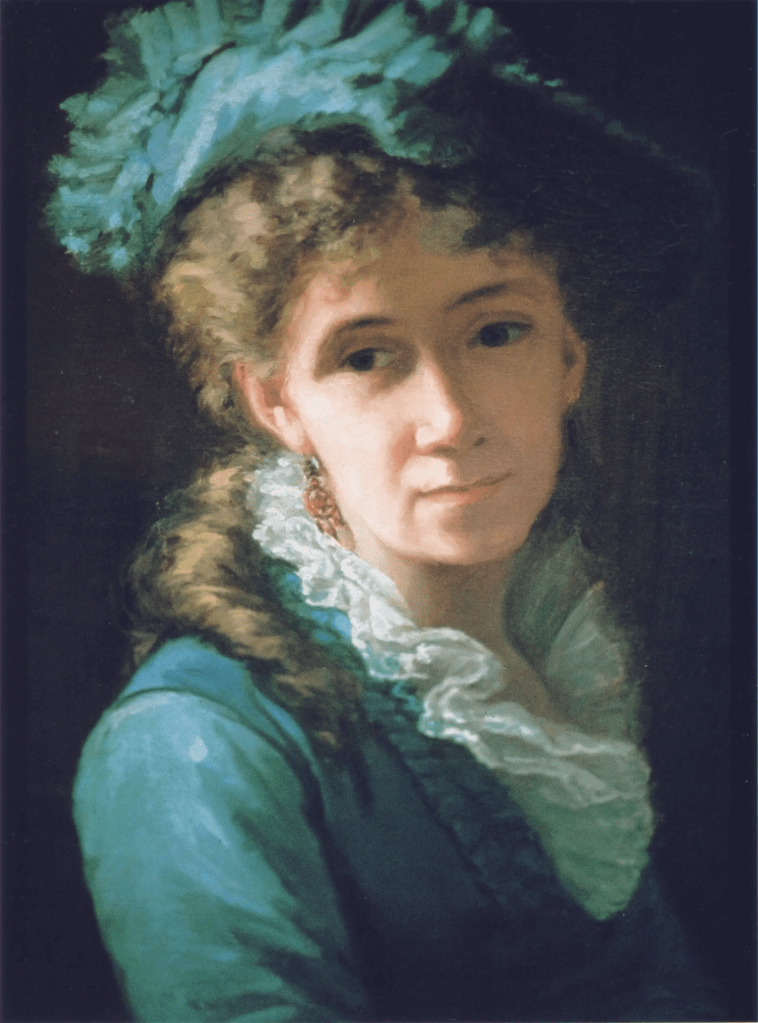
courtesy of louisamayalcott.org
In the prior chapter, Beth suffers a close call to death. We see the sisters who are still at home, Meg and Jo, relying upon God as they stand vigil around Beth in her sickbed.
All day Jo and Meg hovered over her, watching, waiting, hoping, and trusting in God and Mother, and all day the snow fell, the bitter wind raged, and the hours dragged slowly by. But night came at last, and every time the clock struck, the sisters, still sitting on either side of the bed, looked at each other with brightening eyes, for each hour brought help nearer. The doctor had been in to say that some change, for better or worse, would probably take place about midnight, at which time he would return.
Then we see them make deals with God as they plead for the healing of Beth.
“If God spares Beth, I never will complain again,” whispered Meg earnestly.
“If God spares Beth, I’ll try to love and serve Him all my life,” answered Jo, with equal fervor.
Also, while the older girls are caring for Beth, Amy is praying for Beth as well over at Aunt March’s, in the chapter I just mentioned about Amy’s Will. She is given a little closet by Aunt March’s Catholic housekeeper, Esther, to retreat to in order to pray for Beth.
On the table she laid her little testament and hymnbook, kept a vase always full of the best flowers Laurie brought her, and came every day to ‘sit alone’ thinking good thoughts, and praying the dear God to preserve her sister. Esther had given her a rosary of black beads with a silver cross, but Amy hung it up and did not use it, feeling doubtful as to its fitness for Protestant prayers.
Laurie comes to visit Amy, and she asks about Beth. He tells her to hope for the best with a brotherly hug.
When he had gone, she went to her little chapel, and sitting in the twilight, prayed for Beth, with streaming tears and an aching heart, feeling that a million turquoise rings would not console her for the loss of her gentle little sister.

This time around in the story, Beth lives. Right around this time, at Christmas, Mr. March comes home from the war, in Chapter 22. The chapter concludes with Beth referring to the Pilgrim’s Progress story and playing a hymn. Jo asks her what she was thinking and then Beth says the following.
“I read in Pilgrim’s Progress today how, after many troubles, Christian and Hopeful came to a pleasant green meadow where lilies bloomed all year round, and there they rested happily, as we do now, before they went on to their journey’s end,” answered Beth, adding, as she slipped out of her father’s arms and went to the instrument, “It’s singing time now, and I want to be in my old place. I’ll try to sing the song of the shepherd boy which the Pilgrims heard. I made the music for Father, because he likes the verses.”
So, sitting at the dear little piano, Beth softly touched the keys, and in the sweet voice they had never thought to hear again, sang to her own accompaniment the quaint hymn, which was a singularly fitting song for her.
He that is down need fear no fall,
He that is low no pride.
He that is humble ever shall
Have God to be his guide.
I am content with what I have,
Little be it, or much.
And, Lord! Contentment still I crave,
Because Thou savest such.
Fulness to them a burden is,
That go on pilgrimage.
Here little, and hereafter bliss,
Is best from age to age!
Part 2 of the book sees Jo spread her wings as a young single adult. She goes to live in Boston to work as a governess. While living in the big city, she meets the German professor Dr. Bhaer. She also meets people who argue in favor of atheism. These arguments confuse Jo, until Dr. Bhaer defends belief in God and religion.
He bore it as long as he could, but when he was appealed to for an opinion, he blazed up with honest indignation and defended religion with all the eloquence of truth—an eloquence which made his broken English musical and his plain face beautiful. He had a hard fight, for the wise men argued well, but he didn’t know when he was beaten and stood to his colors like a man. Somehow, as he talked, the world got right again to Jo. The old beliefs, that had lasted so long, seemed better than the new. God was not a blind force, and immortality was not a pretty fable, but a blessed fact. She felt as if she had solid ground under her feet again, and when Mr. Bhaer paused, outtalked but not one whit convinced, Jo wanted to clap her hands and thank him.
In Chapter 36, Beth again struggles with her health. She can tell she is dying. Jo has just rejected a marriage proposal from Laurie, saying that she thought Beth loved him. She and Beth talk about this and Beth’s impending sense of death.
“Why, Jo, how could I, when he was so fond of you?” asked Beth, as innocently as a child. “I do love him dearly. He is so good to me, how can I help It? But he could never be anything to me but my brother. I hope he truly will be, sometime.”
“Not through me,” said Jo decidedly. “Amy is left for him, and they would suit excellently, but I have no heart for such things, now. I don’t care what becomes of anybody but you, Beth. You must get well.”
“I want to, oh, so much! I try, but every day I lose a little, and feel more sure that I shall never gain it back. It’s like the tide, Jo, when it turns, it goes slowly, but it can’t be stopped.”
“It shall be stopped, your tide must not turn so soon, nineteen is too young, Beth. I can’t let you go. I’ll work and pray and fight against it. I’ll keep you in spite of everything. There must be ways, it can’t be too late. God won’t be so cruel as to take you from me,” cried poor Jo rebelliously, for her spirit was far less piously submissive than Beth’s.
Simple, sincere people seldom speak much of their piety. It shows itself in acts rather than in words, and has more influence than homilies or protestations. Beth could not reason upon or explain the faith that gave her courage and patience to give up life, and cheerfully wait for death. Like a confiding child, she asked no questions, but left everything to God and nature, Father and Mother of us all, feeling sure that they, and they only, could teach and strengthen heart and spirit for this life and the life to come. She did not rebuke Jo with saintly speeches, only loved her better for her passionate affection, and clung more closely to the dear human love, from which our Father never means us to be weaned, but through which He draws us closer to Himself. She could not say, “I’m glad to go,” for life was very sweet for her. She could only sob out, “I try to be willing,” while she held fast to Jo, as the first bitter wave of this great sorrow broke over them together.
In Chapter 40, Beth passes away. The family shows trust in God, with no feeling of resentment or bitterness over the tragic death of such a young family member.
So the spring days came and went, the sky grew clearer, the earth greener, the flowers were up fairly early, and the birds came back in time to say goodbye to Beth, who, like a tired but trustful child, clung to the hands that had led her all her life, as Father and Mother guided her tenderly through the Valley of the Shadow, and gave her up to God.
Seldom except in books do the dying utter memorable words, see visions, or depart with beatified countenances, and those who have sped many parting souls know that to most the end comes as naturally and simply as sleep. As Beth had hoped, the ‘tide went out easily’, and in the dark hour before dawn, on the bosom where she had drawn her first breath, she quietly drew her last, with no farewell but one loving look, one little sigh.
With tears and prayers and tender hands, Mother and sisters made her ready for the long sleep that pain would never mar again, seeing with grateful eyes the beautiful serenity that soon replaced the pathetic patience that had wrung their hearts so long, and feeling with reverent joy that to their darling death was a benignant angel, not a phantom full of dread.
When morning came, for the first time in many months the fire was out, Jo’s place was empty, and the room was very still. But a bird sang blithely on a budding bough, close by, the snowdrops blossomed freshly at the window, and the spring sunshine streamed in like a benediction over the placid face upon the pillow, a face so full of painless peace that those who loved it best smiled through their tears, and thanked God that Beth was well at last.
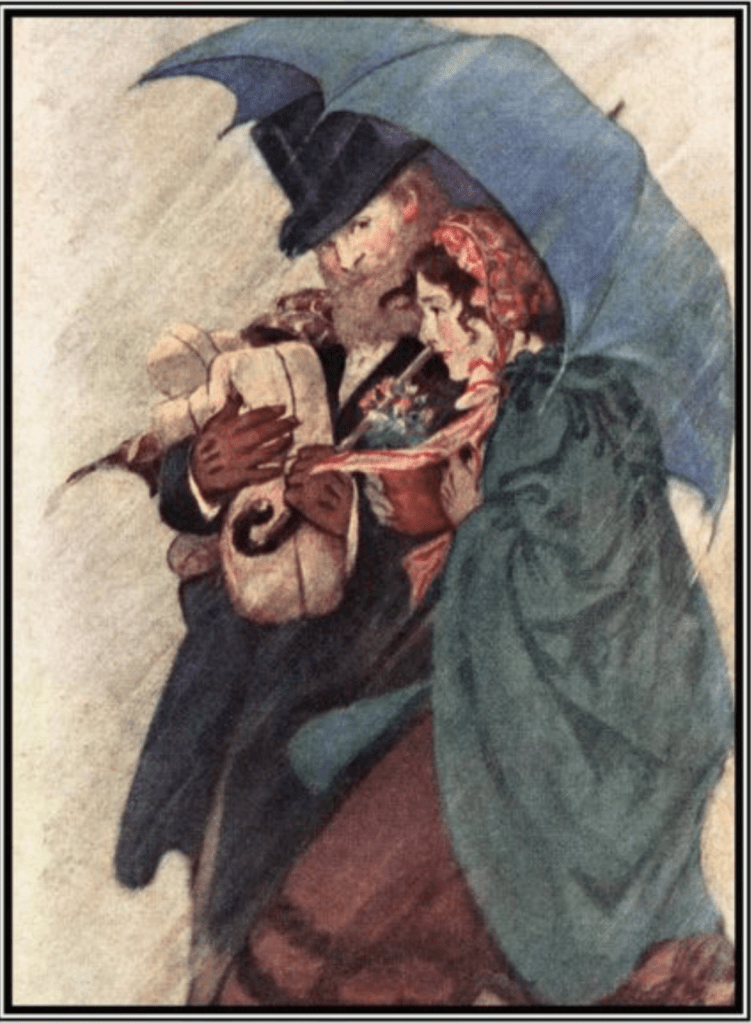
In Chapter 46, Professor Bhaer finally proposes marriage to Jo. But he says he has to go out West for a time to do some work. He asks her if she will wait for him.
“Yes, I know I can, for we love one another, and that makes all the rest easy to bear. I have my duty, also, and my work. I couldn’t enjoy myself if I neglected them even for you, so there’s no need of hurry or impatience. You can do your part out West, I can do mine here, and both be happy hoping for the best, and leaving the future to be as God wills.”
So we see here another mention of trusting in God on life’s journey.
In conclusion, it’s safe to say that Little Women was written by a woman who had faith in God. This faith in God shines clearly throughout her characters and theme of the story. The Pilgrim’s Progress was her model for the book. That makes sense since it was probably her father’s favorite book. Page xxv of the annotated Little Women quotes Bronson Alcott saying that The Pilgrim’s Progress was one of his “bosom companions.” On page xxvi, Matteson says that Bronson borrowed a copy of this book from a cousin and memorized passages. “He called it his ‘dear delightful book” and said that ‘more than any work of genius, more than all other books, the Dreamer’s Dream, brought me into living acquaintance with myself.’ Page xxvii of the same book says that Louisa wrote in her journal that her father read aloud passages from this book to his children. No doubt this influence carried over into the book. It is God’s power that helps the Little Women overcome their faults, and God’s power that helps us all overcome our faults as well. This reflection of human nature and God’s nature is why Little Women has endured as a classic, never going out of print in over 150 years. It has also inspired more than one movie adaptation. Unfortunately, the faith in God and the Pilgrim’s Progress themes don’t come through clearly in the movies. I look forward to the day when someone will produce a movie that is as close an adaptation to the book as the 1995 BBC version of Pride and Prejudice is to that book of the same title. Then it will be as easy to find God in the movie versions of Little Women as it is in the book.

Want more Little Women? Watch below as to why the 1994 movie version is better than the 2019 one. I agree with the reviewer’s take.
Go here for my review of the 2019 movie.
Go here for a review of a LW cookbook and a link to LW paper dolls.
Here’s my review of a biography of Louisa and Marmee.
 Tree of Life Mothering