Here’s a super simple way I am currently using Come, Follow Me. What makes it super easy is that you tack it onto a habit you already have, which is eating! Use this over dinner or whatever meal you commonly share with your family. If you don’t commonly share a meal, then fix a bowl of popcorn or some cookies and sit down to enjoy a snack or dessert together.
1. First, I do one of the following. I either briefly tell one of the stories from the weekly assigned reading to my children in my own words. Then I show my kids a Bible video on my mobile device, if there is one to go with it. These videos are usually included in the lesson for Come, Follow Me. If you can’t find any videos in the guide for “Individuals and Families” check the guides for Sunday School and Primary. Here is the full playlist.
or
I read the scripture passage mentioned, or we take turns reading each verse, and I ask the kids a question to turn their brain on into “seeking” mode. It’s super important to ask a question before we read, to get them to pay attention. Like for example, we just read one of the passages mentioned in the Easter lesson, 1 Peter 1:3-11. I asked the children before we read, “What words or phrases do you notice as we read that give you a sense of hope?” I briefly scan the section mentioning the scripture passage, to find a question I can ask to get the kids in “seeking” mode. That’s how I found the question about hope.
2. Next, I mention the key doctrine that goes with the video/story. To create more engagement, you could ask your listeners what they think the key doctrine is, or “nugget of truth.” The key doctrines are always printed in bold in the lessons, such as “Jesus Christ gives me hope and joy.”
3. Then I ask a question to get my kids to think of how that doctrine applies to them today. Questions are included in the lessons after the bold heading of the doctrine. Sometimes I even come up with my own questions and use those. Often the study sheets from Emily Belle Freeman in her “Don’t Miss This” newsletter archives have great discussion questions as well. Sometimes I use those. (Click on the link I just made and scroll down to where it says “Download Study Sheet.”)
4. Lastly, I love to write down their answers in a special pretty notebook I have dedicated for our Come, Follow Me Family Study Journal. (Hint: Ross Dress for Less Stores have pretty notebooks for only $2.99! I love them because they are hardbound, have a spiral binding so I can attach a pen with a clip inside the coil, and they often have a Bible scripture printed on the cover.) This is becoming a treasured family keepsake as the kids tell me things I’ve never heard before. I am getting delightful peeks into their souls.
The past two Thursday nights I’ve had two book club discussions, one online and one in person. I loved every single minute of them. For the first one we discussed Little Women, and for the second one we discussed anything by C.S. Lewis.
I looooove Sarah Mackenzie’s idea to make your child’s reading life (whether or not you homeschool) less like school and more like a book club.
It’s all about food and connection. Doesn’t that sound wonderful?
For example, here is a quote from Little Women that three other women and I bonded over in our online book club, from the part where Beth expresses gratitude to Laurie’s grandfather for giving her a piano:
If the roof of the house had suddenly flown off, the old gentleman wouldn’t have been more astonished. But he liked it. Oh, dear, yes, he liked it amazingly! And was so touched and pleased by that confiding little kiss that all his crustiness vanished, and he just set her on his knee, and laid his wrinkled cheek against her rosy one, feeling as if he had got his own little granddaughter back again. Beth ceased to fear him from that moment, and sat there talking to him as cozily as if she had known him all her life, for love casts out fear, and gratitude can conquer pride. When she went home, he walked with her to her own gate, shook hands cordially, and touched his hat as he marched back again, looking very stately and erect, like a handsome, soldierly old gentleman, as he was.
One of my new online book club friends expressed how much she loves that particular phrase “for love conquers fear, and gratitude can conquer pride.” So then I asked the ladies if they had ever experienced a time of love conquering fear, or gratitude conquering pride. What followed was a delightful peek into the soul of those who shared.
So I’m transforming our family life to be like that. (The way I am discussing the New Testament using Come, Follow Me questions around the dinner table is helping. See my blog over here for that.)
Want to know more how to create a book club culture in your family? Sarah can help.
Here is Sarah on her podcast reading aloud Chapter 6 of her book, The Read-Aloud Family, about creating a book club culture at home.
(Hint…you can get the Read-Aloud Family for only $1.99 on Kindle right now! I don’t know how long it will last. What’s great about that is you can have the book lists handy right on your phone to look up books at the public library.)
If you want even more details, she did two podcast episodes about this recently, based on her Master Class called “How to Create a Book Club Culture at Home.”
I have one kid in particular who would be very motivated to read and discuss a book if I told him we would go out for a hamburger date to discuss the book when he is done reading. I am going to do this! Why didn’t I think of this before?! I’ve done parent mentor dates before, going out to eat, but I didn’t think of using it as an opportunity to discuss a book. You don’t even have to have read the book yourself, as Sarah teaches. Here is a brief summary of what Sarah teaches, over here.
Today’s tradition for a Christ-centered Easter is so lovely. It comes from Serbia. In the video above, Emily Freeman says that her son learned about this tradition on his mission. In Serbia, for a long time it was illegal to believe in Jesus Christ, according to Emily in the video. Watch it to learn about the tradition of how Serbia, red Easter eggs, women and Mary Magdalene all connect. This web site here says that Good Friday is the day when Serbians traditionally dye their Easter eggs red to prepare for Easter Sunday. So I am going to do that tomorrow, after our Shakespeare play practice! I love how easy this new tradition will be for me! I’m also going to invite Grandma to share her testimony of Christ with us via Zoom.
Today’s eyewitnesses accounts of the life of Jesus come from Nicodemus and Joseph. Please watch the video above to hear Emily Freeman and David Butler share about what they did for the Savior. What can we each do for the Savior in the here and now? What is the finest and best that we can give? I love these two family traditions they suggest in the video.
Did you all enjoy yesterday’s suggestion for Day #1 of the Holy Week of finding a tree branch to decorate your home, to remind you of palm fronds and how the Jerusalem people honored Jesus on Palm Sunday? My little guy found a beautiful branch of a mesquite tree (with thorns-ouch!) that is gracing our dining room table now. I found a wonderful explanation about Jesus riding in on a donkey to fulfill prophecy in the BYU Roundtable Discussion below.
Today’s video from David Butler and Emily Belle Freeman is about Simon the Cyrenian. I love the points they make about him and how they help us relate to Simon and ultimately, how to relate to Christ.
What compelling stories of people have you come across as you were “passing by” as Simon was? How did you get involved in their story?
Whose burden can you carry for a time as Simon did for the Savior? My kids and I talked about the latter question this morning in our devotional, and we will talk about it more and the other questions tonight over dinner. I am going to get some jute so we can make bracelets and remind ourselves to look out for people as we pass by, who we can help.
Tuesday of the Holy Week was probably the day that Jesus engaged in long debate with his critics, as told in Matthew 22. During this debate, he told some parables. I had a great personal scripture study this morning as I delved into the meaning of the parables and discovered why he told them. What was the meaning of the wedding garment? What did Jesus mean about “many are called but few are chosen”? The video below helped me find answers.
Here’s Day #1 of our week before Easter. Every day, David Butler and Emily Belle Freeman of the Don’t Miss This Come, Follow Me YouTube videos are sharing truths from one eyewitness of Jesus the Christ. They also share a simple idea for decorating your home as a tradition.
Today’s eyewitness is actually the collective people of Jerusalem who honored Jesus on Palm Sunday when he came riding through Jerusalem on a donkey. Before he did so the people spread palm branches down on the ground for the donkey to walk. Today’s tradition, in honor of Palm Sunday, is to cut down a tree branch, akin to a palm branch, and put it in a vase to decorate your home and remind you of honoring Palm Sunday and Jesus.
Jesus came on a donkey to fulfil prophecy. How do you see Jesus coming into your life to fulfil prophecy? By contrast, how do you see him coming in unexpected ways?
In the video above Emily shares that she has been learning from the book Jesus the Messiah by Alfred Edersheim. You can get a free PDF copy of that here.
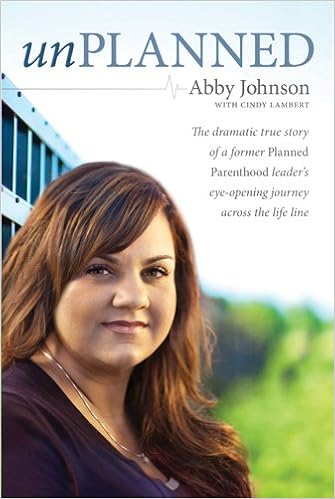
Have you heard about the new movie Unplanned? It was released March 29. It’s based on the book of the true story of Abby Johnson.
The trailer for the movie is at the very top. Abby went from being the director of a Planned Parenthood clinic, and having two abortions herself, to being an outspoken critic of abortions. The book and movie show how this happened.
I’ve been binge-watching her interviews and speeches on YouTube. I am thrilled to hear her conversion story! To Christianity, to the pro-life movement, to motherhood, and to the Creighton method of fertility awareness. She is now the mom of 7 and pregnant with baby #8.
Wow! I love her mission as a mom and her ministry to uncover the lies of Planned Parenthood and fight against abortion. She says that her mission is to make abortion not just illegal, but unthinkable.
In one of the videos I found of her speech in Austin, TX, the guy who introduces her calls her “manna from heaven for the pro-life movement of Texas.” Amen!
She is uniquely positioned to tell of the lies of Planned Parenthood since she used to work for the organization. She has exposed that they aren’t really about women’s health, but about money. Way to go Abby! You go girl! So here are a bunch of videos for you to binge watch the joy and conversion of Abby.
She has a website here telling her story and a sister site here, to help abortion workers leave the business like she did.
She adopted a baby who typically would have been aborted, a biracial baby who was conceived from rape. Wow. I learned from Abby that Margaret Sanger, the founder of Planned Parenthood, was a eugenist who wanted to abort babies of African American mothers. That plan is being realized as something like 70% of abortions in the U.S. are of African American mothers, according to Abby, in one of her speeches.
Nancy Campbell, of Above Rubies fame, endorses Abby’s movie, in Nancy’s podcast called, “From Our Home to Yours.” Nancy’s been doing a series of podcast episodes lately about turning our world to a culture of life, called “How We Can Change the World.” In podcast episode 45, she mentions Abby’s movie and says that she saw it twice. In one of the episodes she quotes the Bible, 1 Timothy 2:15, which says that women “will be saved through childbearing—if they continue in faith and love and holiness, and with self-control.”
It’s so true. Having children and breastfeeding them unrestrictedly provides lower cancer risks, increases mental wellness, and gives women a purpose they have never felt before. Of course, being a woman is not just about being a mother. Of course, women are meant to be more than baby machines. That being said, having children is a huge blessing, both physically and mentally! It is a blessing to cultivate and treasure.
Listen to her whole podcasts of “How We Can Change the World,” starting with Episode 35, to learn more. It’s so interesting that she points out in episode 45, linked above, that an anthropologist studied women in Africa who breastfed frequently. These women experienced lactational amenorrhea, and as a result had fewer than 100 periods in their lifetime instead of the average American women who has over 400. The anthropologist found the African women to be healthier because of this.
Dear fellow women, our conveyor belt system of covering up, chemically changing, and destroying our fertility is destroying us! As Abby Johnson says in one of her speeches, fertility and having children is not something to be broken, but something to be embraced. Women should not be told that their fertility has to be broken in order to be successful. True women empowerment is being in tune with our fertility, and embracing it as mothers, physically if we can, and in spirit, if we can’t bear our own children.
I love that Abby promotes the Creighton method of fertility awareness. In the video below she talks about that and how abortion is tied to contraception. Sisters, I hope you see yourself as a beautiful tree which has seasons of life to enjoy. I have written about that here.
For Come Follow Me Study Week #14, I read Matthew 14–15; Mark 6–7; and John 5–6. The story of the miracle of the loaves and fishes is in these scriptures, shown in the video above, and Jesus and Peter walking on water, shown below. I love these stories. They are incredible! We can all benefit from exercising faith that our humble offerings of time and effort, will be multiplied by God just as the loaves and fishes were. I totally rely on this thought in my homeschooling and mothering efforts. We can also all benefit from thinking of Peter trusting in Jesus in order to walk on water.
You can watch the video at the very end of this blog post to hear some questions about how to relate those stories to your own life from my new YouTube friends, David and Emily. (I don’t know them in person, I just watch their videos every week for Come Follow Me so I feel like they are old friends now.)
For today’s post, I am focusing on a lesser known story in these verses. I am focusing on the story where Jesus tells the multitude that it’s not what goes in the mouth that defiles a man, but what comes out. Then his disciples reported to Jesus that the Pharisees were offended by this. These verses in these scriptures about the heart and mouth fascinate me! Here is the response from Jesus, from Matthew 15:17-20:
17 Do not ye yet understand, that whatsoever entereth in at the mouth goeth into the belly, and is cast out into the draught?
18 But those things which proceed out of the mouth come forth from the heart; and they defile the man.
19 For out of the heart proceed evil thoughts, murders, adulteries, fornications, thefts, false witness, blasphemies:
20 These are the things which defile a man: but to eat with unwashen hands defileth not a man.
So the heart and mouth are connected according to Jesus. How so? Let’s talk about the mouth first. Jesus says that what comes out of the mouth is more important than what goes into the mouth. I looked up “mouth” in Hebrew. (I do this often with my word studies, because the ancient Hebrew pictograms have keywords that uncover deep layers of meanings of words.) Here is mouth in Hebrew:
פה
pronounced as “peh”
These characters, from right to left (since Hebrew is read from right to left) are “peh” and “hey.” So, the word for mouth sounds the same as the name of the beginning letter of the word.
Here are the ancient Hebrew pictograms for the above Hebrew letters.
פ=peh=mouth
ה=hey=stick figure man with arms held up by head
Here are the keywords for those pictograms:
(פ=peh=open, scatter, edge, blow)
(ה=hey=behold, reveal, breath, covenant, look)
So after analyzing these keywords, I decided on using the two keywords of “open” and “reveal” to synthesize the two letters’ meanings into one meaning. So here we go for the meaning for mouth: “Open up to reveal.”
Ok, now how about the heart? In Hebrew, heart is this:
לב
which is pronounced as “lev”
These characters are, from right to left, “lamed” and “bet.” Here are the pictograms that go with them:
ל=lamed = shepherd’s staff
ב=bet = tent floor plan
Here are the keywords to go with the letters:
ל=lamed=teach, yoke, authority, bind
ב=bet=tent, home, house, family
So here is the meaning of “love/lev” in Hebrew: “The thing, that like a shepherd’s staff, leads one into or binds one to the house/home.” The house/home of who? God! I love that! When something resonates with our hearts, it is because it is something that leads us back to God, our Heavenly Father, and our heavenly home and eternal family.
So…now combine these meanings of the two words of mouth and heart. The things that come out of our mouth, come from the heart and attract either light or darkness. The mouth shows what is in the heart. If we speak God’s words, if we speak positively, if we speak truth, especially prayers to Him, praising Him and pleading for help, we can change our hearts to be like His, and we can change what happens in our environment too. Opening up our mouth with positive words, may feel like a literal stretch of the heart and the lips, but it allows for revealing, both for man to reveal what is in heart, and for God to reveal to us His works and love.
Nephi, in the Book of Mormon, is such a powerful example of this. On the ship crossing the ocean, Nephi was tied up in cords by his brothers. Did he complain? No. Did he use his mouth to be negative? No. He used his mouth to open up and allow positivity to come forth. He praised God all the day, while bound in cords. As it says in 1 Nephi 18:16, “Nevertheless, I did look unto my God, and I did praise him all the day long; and I did not murmur against the Lord because of mine afflictions.” Nephi was bound for at least four days. I assume he kept up the praise. Then what happened? God revealed to Nephi His work. God used His power, which was the only power which could soften the brothers’ hearts, to cause a storm and rough ocean, to terrify the brothers, threatening them of death. 1 Nephi 18:20 says:
And there was nothing save it were the power of God, which threatened them with destruction, could soften their hearts; wherefore, when they saw that they were about to be swallowed up in the depths of the sea they repented of the thing which they had done, insomuch that they loosed me..
God is definitely in the business of making us more than we are. That is why He sent His son to redeem us. He wants to tame us, to open us, to stretch us so that we are able to receive all that He has, as joint heirs with Christ. Our first step to doing this is to open up our mouths and stretch our spirits to say what He wants us to say, which may not exactly match reality at the moment. He wants us to say not the negative that is, but what can be, to praise Him even in adversity. This is what Nephi did.
I’ve been working on this a lot lately. Of course it’s easier said than done. It’s so easy to whine and complain and be negative. I feel so justified when I have been hurt, offended, or in bad circumstances. I feel like I have a right to complain! That is the easy, tight, closed way. I commit to open my heart and mouth to God and praise instead of complain.
In our home, we have “do-overs”, which I learned from author Nicholeen Peck, when I catch the kids being sassy or impolite or downright rude. I say my words to them politely, and then I have them practice talking politely back to me. We do it until they get it. (If they won’t obey to have a “do-over” they get a strike. Three strikes means they are “out of instructional control” which means they earn an extra job. They don’t get any free time, play, or fun, until that extra job is done. That’s my modified version of Nicholeen’s Teaching Self Government child discipline.)
I’ve noticed sometimes I need “do-overs” too. So I do them. It feels great to speak more positively and work on having soft words so we will have soft hearts and open up to God’s words and works. I invite you to do it too!
So, in my Veggie Gal group we’ve been talking about something we’ve never covered before…how often to have “marital relations.” We’ve been pretty frank over the 20+ years of our dinner/lunch group, talking about enemas and colonics and such, and we have talked a little about sex, because on one Friday night, one of us said she wanted to get home early to enjoy it with her husband :-), but this is the first time we’ve broached the topic of how often. One of the VGs, Shauna, pointed out that a friend of hers who is a yoga guru, teaches and writes about yoga. Said yoga guru quoted another yoga guru, who claims that sex should be had in moderation, even in marriage. It has health benefits, but too much of it will wear one out, like a car wearing out its batteries, he says.
Hmmm…I wonder what she and he think is “moderation”? Not every day? Not every other day? Not more than once a week? Not more than once a month? Hopefully not to the point of being like Gandhi, who quit enjoying it altogether, right?
I also wonder what they all would think about the Trim Healthy Mama (THM) Foxy Mama challenge.
In Chapter 34 of the big, fat, original THM book pictured above, the Trim Healthy Mama sisters, Serene Allison and Pearl Barrett, give a low-down on all the benefits of married sex. Wow, I didn’t know about any of these physiological benefits. No wonder married people tend to be healthier! I won’t go into details…just go read it! Your husband will love you for applying what you learn! 🙂
Then they did not one, but two podcast episodes about it, with a “THM Foxy Mama Challenge.” The THM Foxy Mama challenge is to go for it at least twice a week. They explain why in the podcast. Does this challenge conflict with ancient yogi wisdom? Is that too frequent?
If you are more of a listener type, you can listen to Part 1 of the Foxy Mama podcast here. Go to the bottom of the page and click on the arrow. (The huge icon for the podcast won’t match the episode’s title.)
I discovered a hack for making one of my favorite staple foods, DIY Greek yogurt. This is the perfect method if you have to be gone all day, or need Greek yogurt in the morning when you wake up, but you are almost out, and you don’t want to get up in the middle of night to incubate your yogurt and wrap the crockpot in a towel. In other words, you can make yogurt while you are sleeping, out playing, or running errands! No babysitting the yogurt required, to catch the right time to incubate it with the starter. No checking the temperature. No wrapping the crockpot with a towel.
I did this method last week when I had to be gone all day for our homeschool group classes (commonwealth) which lasts all day, with a 90 min drive each way. When I got back, the yogurt was done! I just had to strain it for an hour or two to make it into proper Greek yogurt, which is strained yogurt so that it has the creamy thickness so characteristic of Greek yogurt.
Pour a gallon of milk in your crockpot.
Add 2 T starter plain yogurt with active cultures.
Cover with lid, turn the setting to “warm” and make sure the crockpot is plugged in. 🙂
Go run your errands or go to bed!
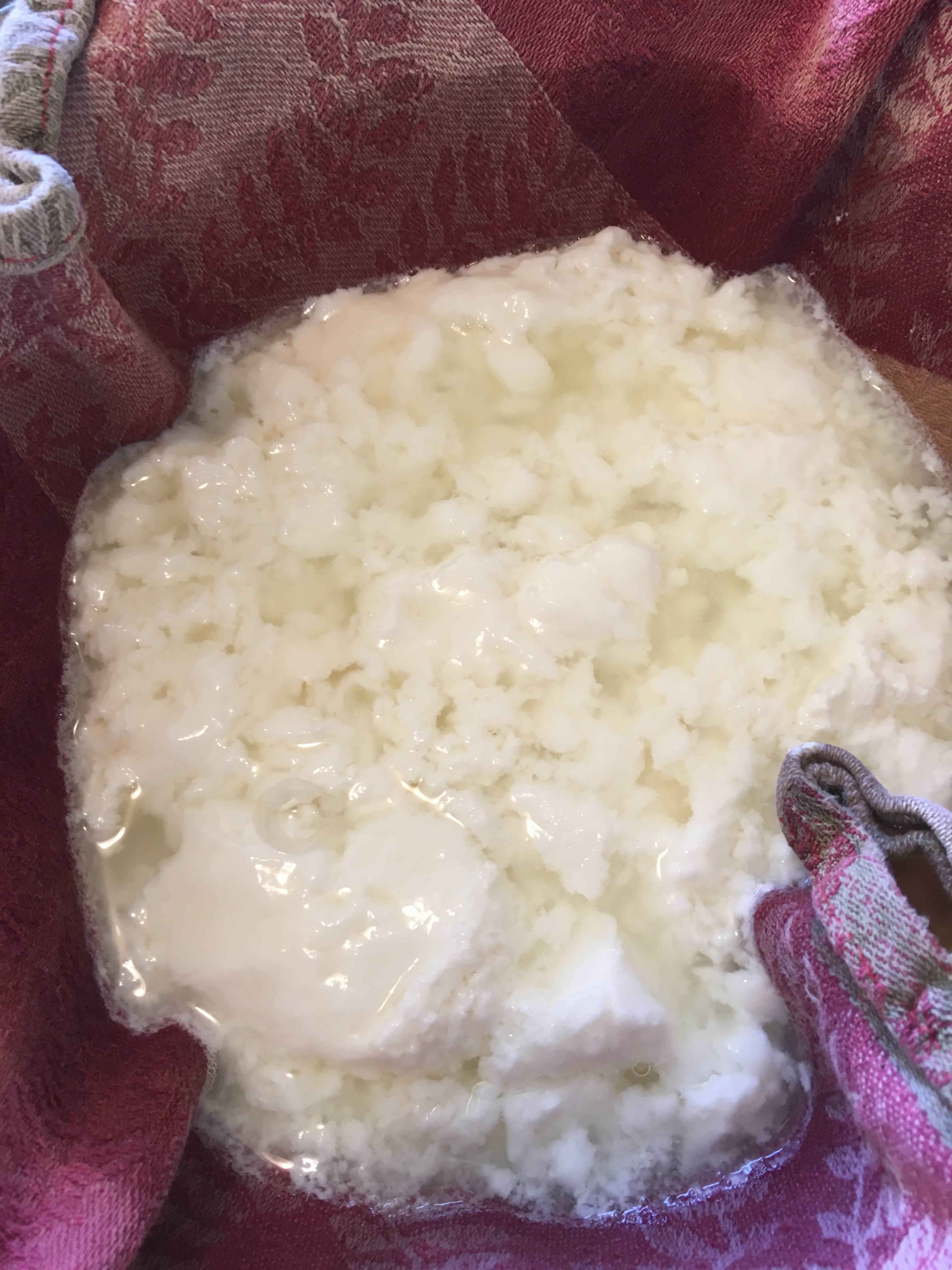
After about five to six hours, or overnight, you will see that the yogurt has formed. It will look like this:
(Note: The last time I tried this method, it didn’t work. I had to start it over my traditional way. So it’s not foolproof, I’m not sure why. Stay tuned…maybe I will figure it out.)
The yellowish liquid is the whey.
6. Ladle the yogurt/whey mixture into a colander or strainer placed over a pot that is lined with a clean dish towel.
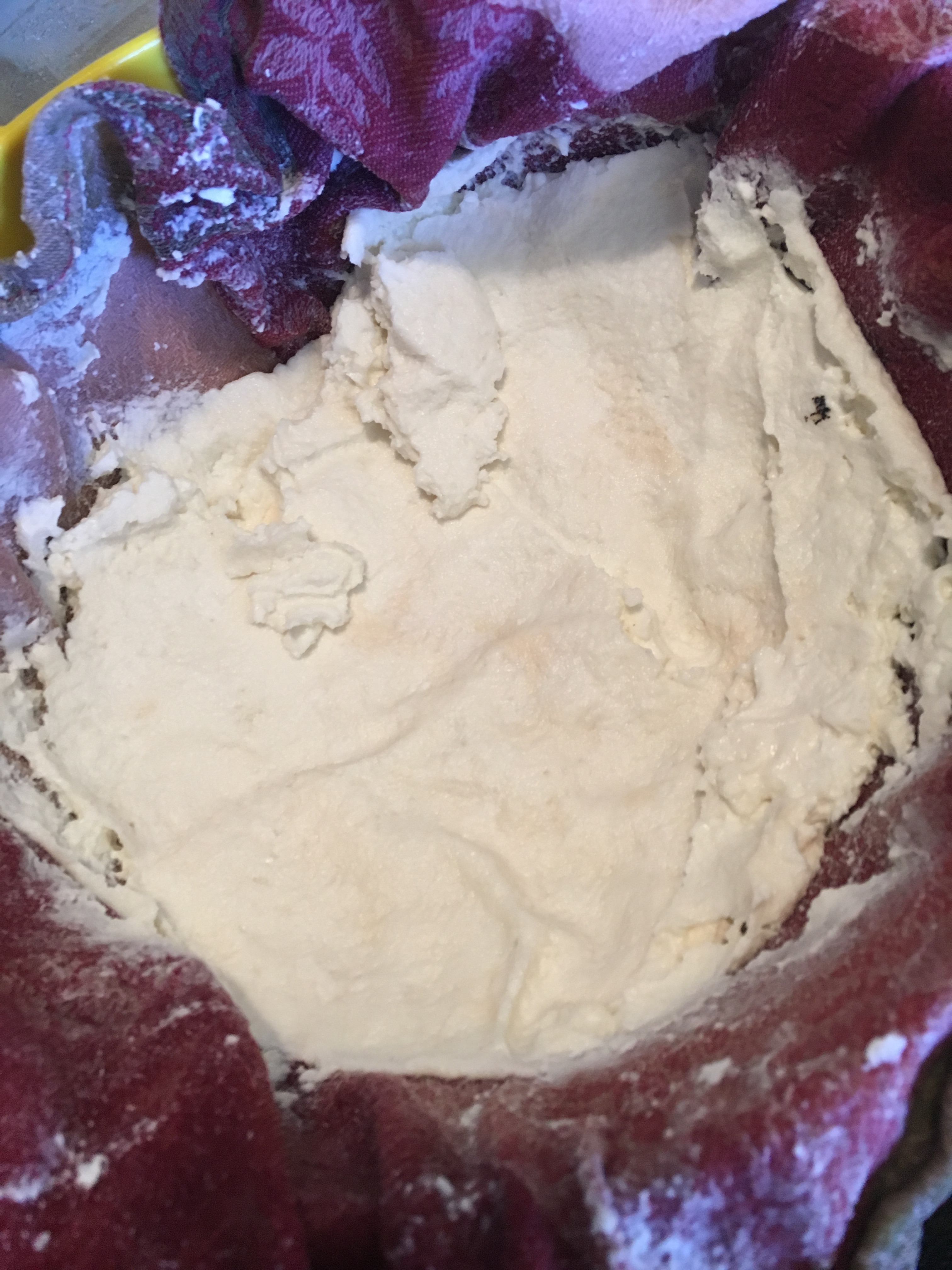
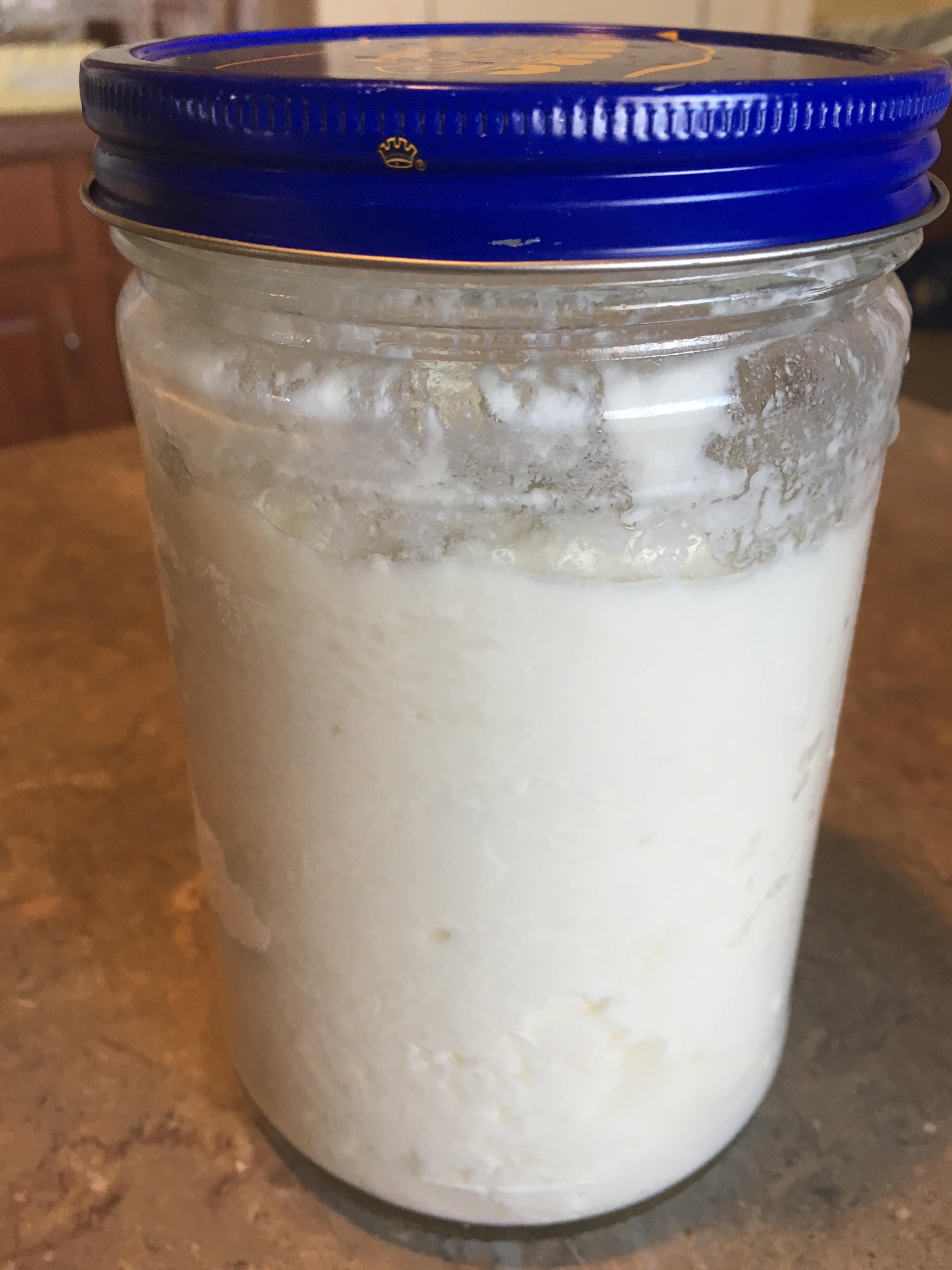
7. Let the whey strain off until yogurt is your desired thickness. You can dump the whey or save to soak grains or lacto-ferment veggies. If you strain the yogurt for too long it turns really thick, so that you have “yogurt cheese.” If you get it too thick, you can always add a little water and blend in blender if you want to get it to the creamy texture and thick consistency of commercial Greek yogurt. This is what it looked like after 2 hours.
Top with your favorite toppings and enjoy! I love to top it with my homemade chocolate, crushed up, and honey or stevia. Super yum!
I have noticed that this method doesn’t yield as much yogurt, compared to my original crockpot method. More of the milk turns to whey than with my other method, leaving less yogurt. I’m not sure why. See photo below. This is my yogurt made my traditional way, where I babysit the yogurt by timing, unplugging, testing the temp with my pinky finger, incubating in the middle of it, and then wrapping.
See how this version has a lot less whey? You can hardly see it. So I don’t use this hack method all the time, just when I am in a pinch and have to be away or asleep.
I used to store my yogi in recycled plastic Mountain High yogurt containers. But now I store it in recycled glass Adams peanut butter jars in my fridge. This is my go-to protein source when I have to grab something quick to travel and know I will need a meal while I’m gone. (As the Trim Healthy Mamas say, a meal involves protein.) The jar size is perfect for keeping a spoon stored in the jar with yogurt for my travels, and I don’t have to stress about the lid popping off, which could easily happen to the recycled plastic yogurt containers. When traveling, I eat a cup for each meal for my portable protein source. So if I know I’m going to be gone all day I will take a fairly full jar. Since my kids won’t eat it I don’t have to worry about contaminating it with my germs by putting my used spoon back in it. I’m actually glad they don’t eat it, it means more for me!
I do two batches of 0% milk a week for when I want to combine the yogurt with a carb (so the fuels don’t clash in Trim Healthy Mama lingo) in the crockpot and one batch of full fat milk (for when I want high fat meals), mostly for me, and a little for my dh’s lunches. I keep the crockpot out on my counter and do these three batches in three days, then clean out the crockpot and start over the next week. If my kids ate it I would be making the yogi round the clock. 🙂 So, let’s just keep it a secret that the yogurt is yum as long as you sweeten it up, shall we? 🙂

![The Read-Aloud Family: Making Meaningful and Lasting Connections with Your Kids by [Mackenzie, Sarah]](https://images-na.ssl-images-amazon.com/images/I/51gMlecMsrL._SY346_.jpg)






 Tree of Life Mothering